ATN26 Conference: The lowdown

Updated: Mar 23
By Meera Dattani
In its sixth year, the Adventure Travel Networking (ATN) Conference took place in London on Thursday 26th February. Founded by Pru Goudie, the conference welcomed 160+ delegates for a day of stimulating and interesting panel discussions and networking.

“Between geopolitics, economics and global challenges, the juggling act to evolve as a business is as intriguing as ever,” said ATN moderator Jono Vernon-Powell in his introduction. Little did anyone know the world would change again two days later.
Kicking off with 2026 Market Insights & Adventure Travel Trends, Roy Barker of SPIKE Insight shared his findings from a survey of Adventure Travel Show attendees and industry reports. “Growth is coming from group tours and tailor-made, then self-guided,” Barker told attendees, with cycling and e-biking on the up. “The booking window is shrinking, with people booking closer to departure. Price is at the top of decision-making.”
Sustainability last on the list perhaps reinforces the need to embed such experiences versus selling trips based on sustainability credentials. Ashley Toft, CEO of KE Adventure Travel, has also seen increased interest in cycling, particularly e-biking: “It allows people with different fitness levels to travel together.” For Tobin, solo travel is on the up, citing a recent India trip in which half the group were single or solo, but seeking community.
Roy Barker, SPIKE Insight; Clare Tobin, Wild Frontiers; Ashley Toft, KE Adventure Travel
When it comes to AI, about a third are adopting it, another third exploring it, said Barker, administratively than strategically. Wild Frontiers’ CEO Clare Tobin said they’d lost blog traffic but have learnt a great deal. “People are asking, for example, ‘What can I wear in Saudi Arabia?’ so we’re responding.” Is she worried about AI from a trip-planning perspective? “We’ve seen itineraries on AI – we’ve run ours through AI and they can’t be replicated.”

What about geopolitics? “We’re agile,” said Tobin. We cover 61 destinations so if something is happening in Pakistan, we’ll focus elsewhere.” And the Trump effect? “We don’t have a single booking to the States,” Toft said. “On the other hand, 2025 was our best year for Greenland!” It seems all PR really is good PR.
*******************
If Greenland emerged last year, what’s emerging now? Angola, Central Asia and China, according to the panel on emerging destinations. Moderator and Wanderlust’s founding editor Lyn Hughes also shared stats from a readers’ survey showing nearly 60% actively avoided overtouristed placesChina is very much in demand, said Intrepid Travel’s Joanna Reeve. “Our family product is 189% up.” They’re also seeing 30% year-on-year growth in women’s expeditions; increased interest in north Africa particularly with the solar eclipse, and travellers seeking further-flung places in nature. “It’s more escaping from than escaping to.” Reeves also referred to Intrepid’s annual Not Hot List spotlighting places such as Sierra Leone and Croatia’s Vis Island. “We featured Ghana last year and doubled our sales.”
Joanna Reeve, Intrepid Travel; Tim Henshall, Angola Tourism; Sophie Ibbotson, Maximum Exposure;
For Henshall, who’s marketed Africa for many years, it’s Angola. “I’ve been to 25 African destinations and Angola left me breathless. But it gets fewer visitors in a year than Tanzania gets in a day.” He also emphasised looking beyond the obvious; think, western Africa, Equatorial Guinea, southern Tanzania, Kafue in Zambia, Algeria and Tunisia away from bucket-and-spade trips.
Uzbekistan - visa-free and with direct flights - leads the Central Asia region, said development consultant Sophie Ibottsom. “Everything you imagine about the Silk Road is there.” A transformational change will be Wizz Air’s flight to Yerevan as Armenia hope to replicate Georgia’s success in the UK market. There are hopes for a direct flight to Kyrgyzstan too.
Ibbotsom also reported more interest in Pakistan thanks to improved security and infrastructure, plus direct flights from Manchester and soon, London: “From a tourism perspective, it has everything India has.” She also recommended Uzbekistan and Pakistan as a twin-centre, with direct flights between Tashkent and Islamabad, and highlighted winter sports across central Asia and Balkans (bar Turkmenistan). “People are afraid of going in winter, but it’s 20 degrees in Jan. This isn’t Siberia!”
*******************
‘Worst case scenario - protecting your business when the world shifts’ could not have been more timely. How can businesses continue, amid a backdrop of changing FCDO advice, airspace closures and geopolitical instability? asked moderator Vernon-Powell.
“Be closer to the facts,” recommended John Telfer of risk crisis specialist Sanderson Philips. “Just operating in a country for some time isn’t enough: Understand the destination and how it operates.”

John Telfer, Sanderson Philips; Martin Alcock, TTC; Claire Ingleby, mb LAW; Katherine Atkinson, The Safer Tourism Foundation
But not all dangers are external. “The Safer Tourism Foundation helps prevent people from dying/serious harm on their travels,” said its CEO Katherine Atkinson. “We look at millions of trips a year and data: Many times, it’s customer behaviour. When I do something stupid on holiday I wouldn’t do at home, I call it my ‘holiday head.’”
One reason is optimism bias, she added, that bad things happen to ‘other people’. It’s also about recognising risk variables e.g. the triple challenge of older travellers, heat-related illnesses, and pre-existing conditions.
“There’s a heavy emphasis on regulation,” said Claire Ingleby, mb LAW, “but we need to educate customers so they play their part in matching that risk.” She suggested conveying key points at time of booking and in the immediate run-up.
”Pre-planning is key, said Martin Alcock of the Travel Trade Consultancy. “Take Mexico with FCDO advice kicking in. Businesses needed to quickly work in 24 hours. Not just passenger welfare, but cash flow, legal position, legal obligations, emergency liquidity.”
*******************
Who is the American adventure traveller and how can UK tour operators attract them? Demystifying the USA market, UK’s most valuable, was the topic for Lyn Hughes, Shannon Stowell of the Adventure Travel Trade Association (ATTA), Fiona Marshall from Walkers’ Britain & Europe, and Wilderness Group’s Paul Easto.

Paul Easto, Wilderness Group; Shannon Stowell, ATTA; Fiona Marshall, Walkers Britain & Europe; Lyn Hughes
American Stowell addressed the “orange elephant in the room” adding “it’s no understatement to say we’ve been a major problem in the world.” When asked if some Americans felt embarrassed to travel, Shannon referenced a seasoned US journalist who cancelled his trip to Europe as he was worried how they’d be perceived.
But demand from US is strong, said Marshall. There are key differences though. “70% of US customers use an intermediary to book their travels, like a travel designer, tour operator or agency,” Easto told attendees.
“Figure out ways people can speak to you with time zones,” suggested Marshall. She also noted practical cultural differences. “Public transport is common on self-guided itineraries, but Americans aren’t always familiar so we made videos on how to buy a train ticket.” She also recommended making the geography obvious. “Say French Alps versus a lesser known national park. And Americans have higher expectations of hotels so look for more comfortable, spacious hotels.”
And price it right. “There’s a market expectation in the US – if it looks too cheap, they don’t want it!,” she said. “There’s a saying, ‘In mystery, there is margin. Have something unique in the itinerary, and you can’t compare it to something else.”
*******************
The first YouTube video was shown 25 years ago, but how should companies approach video content when it comes to building a brand? Green Traveller’s Richard Hammond asked Laura Dewar, Explore Worldwide & Linda Biggers, Pura Aventura, how they are creating meaningful content.
Laura Dewar, Explore Worldwide & Linda Biggers, Pura Aventura
“We mix stock footage and commissioned videos to give an impression of destinations,” said Explore’s Dewar. “We play around on social media with staff and customers to see what works and mix things up to make the expensive shoots pay off.” Very few brands in very few industries would say it’s not worth it. “We have an in-house video editor who can create reels, work with stock shots etc.”

Pura Aventure wanted a brand video that wasn’t too slick, said Biggs, using humour to bring destinations to life. “We started to gain confidence in the shorter clips we’d collected,” she said. “A year ago, the most eyeballs was 400/50. The new one generated 78,000 views in five months.”
*******************
The two letters on everyone’s lips… AI. Disrupt Travel’s Peter Syme and North9’s Tom McLoughlin explained how travel companies can manage changes to Google search and adapt their marketing approach. “Trust is our core advantage,” Syme said. “Tech will automate everything possible so trust and verification is one thing that can differentiate you.”
“You need to think about who your audience is,” said McLoughlin. And don’t forget your database: “Your email list has increased in value dramatically,” said Syme. “If traffic decreasing, double down on what you have.”
Peter Syme, Disrupt Travel and Tom McLoughlin, North9
McLoughlin agrees. “Email should be a living breathing tool, of community-building. All roads should lead into email; then you tell stories, and build that connection.”
*******************
We talk about the positive impacts of adventure travel, but how do we really know? In Rethinking tourism - focusing on impact and measuring what truly matters, Much Better Adventures’ Alex Narracott introduced his AI-powered pilot model, created with Australian tech company Equator, which measures local economic impact and leakage at a trip level. Tourism promises to create jobs, protect cultural heritage and fund conservation, but 50-80% of spend leaks away. “Carbon label has been normalised,” said Narracott. “Economic impact has to go alongside it.”

Alex Narracott, Much Better Adventures; Kasia Morgan, Exodus; Thomas Armitt, Planeterra; Richard Hammond
And demand for proof is growing, with skeptical consumers, greenwashing regulations, certification standards getting tougher. “We built a tool that converts text itineraries into structured data,” says Narracott. “It allocates spend across categories, and tells us what spend stays there. We have a live dashboard for trips - Take Nepal where we have 9 itineraries: 78% spend stays local, and our trips created 66 FTE local jobs last year. For all-inclusive and cruise, it’s 25%.”

Exodus Adventure Travels has collaborated with Responsible Travel’s Justin Francis, said Kasia Morgan, working with local partners in the Baltics and Jordan. “We’ve set out mythology to work out local impact, which communities are disadvantaged and who the beneficiaries are. Phase one is the Who. Then Phase two, How?” They’ll lean on insights from NGO partners and their knowledge and experience.
Planeterra carries out an annual impact study with community partners, said Thomas Armitt. “It takes two months, collecting and verifying data to understand economic impact at a deeper level.” As Narracott says, the tool is not the be-all-and-end-all. “It doesn’t matter if it’s 76% or 78% retention; it shows the main story.”
*******************
Another often-grey area is Indigenous tourism. Genuine cultural exchange or exploitative? A topic Holly Tuppen explored with Paula Amos from Indigenous Tourism British Columbia, and Hanna Lejon, Nutti Sámi Siida, a Sámi-led tourism programme in Swedish Lapland.Nutti Sámi Siida was founded by a reindeer herder who found a way to engage travellers with Sami customs, and create a sustainable, ethical reindeer husbandry business in the process. “The most important thing is the reindeer,” says Lejon. “It’s not a zoo, and it supports Sami way of life.”

Holly Tuppen, Moderator; Hanna Lejon, Nutti Sámi Siida; Paula Amos, Indigenous Tourism British Columbia
Amos has worked at ITBC for over 20 years, seeing it grow from 15-20 market-ready businesses to over 200, all at least 51%-Indigenous-owned. “One in four travellers want to add an Indigenous experience. They come to BC for nature, but want to add culture.”
“When marketing our culture, make sure you have correct information,” says Lejon. “As Sami, we are storytellers. We haven’t been writing things down, until recently. The best way to start is to take part - the biggest impact is our connection to nature.”
It’s similar for Amos. “As Hanna says, emphasis is on oral culture, with stories passed down.” Amos suggests operator visit the ITBC website which lists 10 considerations for operators choosing Indigenous experiences.
*******************
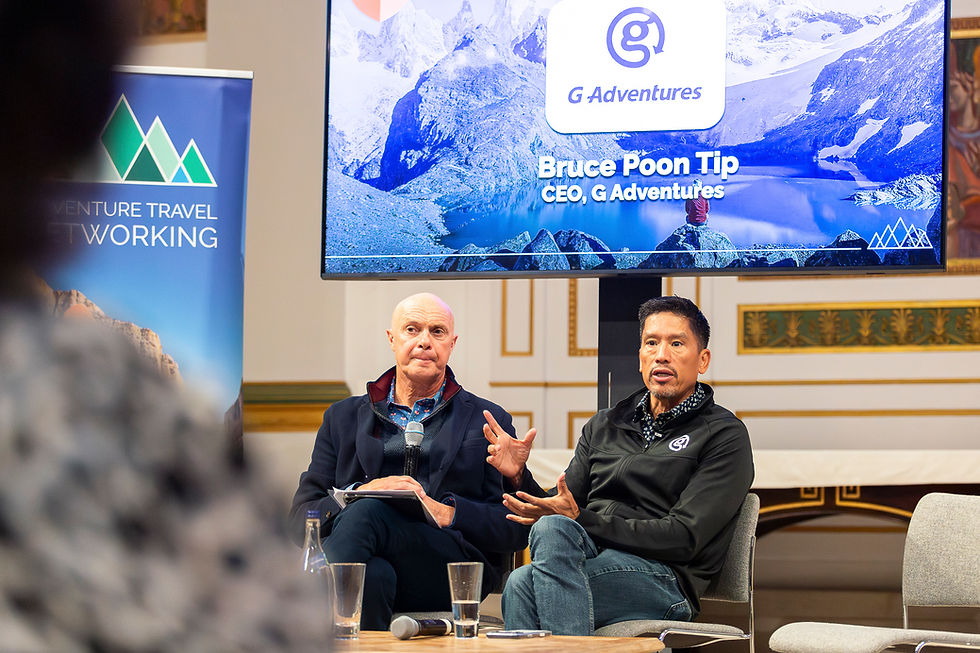
The session ended with a fireside chat between Vernon-Powell and Bruce Poon Tip, founder of G Adventures. As well as celebrating progress in community tourism and how Covid changed the company, for the better, Poon Tip also discussed his entrepreneurial style (“emotional”), leadership challenges, the success of G Lux and Solo-ish, deals with Nat Geo, and a world tour around his new book, and doubling down on DEI. “I’m proudly woke,” he told attendees, “The wokest of the woke.”
*******************
Another year, another ATN conference ticked. Closing the conference, ATN founder Pru Goudie looked ahead to the ATN Media Meet-ups, Midsummer drinks, and ongoing membership programme. From geopolitical upheaval to championing Indigenous tourism, the conference showed once again how adventure travel continues to inspire but also respond to the ever-changing world around us as current world events reinforce the importance of resilience, collaboration and responsibility in an industry that is, first and foremost, powered by human connection.
THE VALUE OF NETWORKING
THE IMPORTANCE OF GIVING BACK
Support the Beehive Fence Project / How Many Elephants
The conflict between farmers and crop-raiding elephant in Tanzania and wider Africa is a huge issue with fatalities on both sides, but there are solutions such as wildlife corridors and yes, beehive fences. These are some of the innovations being employed by How Many Elephants, founded by Holly Budge. “Elephants are scared of bees so they stay away from crops, while bees pollinate crops, and local women make and sell honey.” In Tanzania’s Ngorongoro-Serengeti ecosystem, a 5.5-kilometre beehive fence set up with local NGO Wild Survivors is home to 275 hives and 11 million wild bees. And human-wildlife conflict has dropped by 91%. “In a world of AI and tech, some innovations are still brilliantly
human and rooted in nature,” says Budge.
To sponsor a beehive, visit https://howmanyelephants.org/beehive/

-Ends-
About the Author
Meera Dattani is a freelance travel journalist, and executive editor at Adventure.com commissioning features from writers/photographers around the world.

She focusses on community-led tourism, food/cultural heritage, soft adventure, and wildlife/conservation, and has written for National Geographic Traveller, Wanderlust, BBC Travel, Condé Nast Traveller, Evening Standard, the i paper, and others. She is also Media Advisor to ATN, a mentor, awards judge, and speaks/moderates on panels for the likes of ATN, Women In Travel, IMM, and Destinations. In 2023, she founded TravelWritingWebinars to offer informal
training for travel journalists, and is a former Chair/Board Director of the British Guild of Travel Writers.
ATN26 CONFERENCE SPONSORS